Most compliance problems don't begin with a data breach. They begin with assumptions.
Business owners often assume that because they have antivirus software, firewalls, backups, or multi-factor authentication, they're fully protected. Unfortunately, having security tools in place doesn't necessarily mean they're being managed, monitored, or documented properly.
Whether your organization is preparing for a cyber insurance renewal, responding to a customer security questionnaire, meeting HIPAA requirements, processing credit cards, or simply following cybersecurity best practices, small compliance gaps can quickly become expensive problems.
At Literati Information Technology, we help organizations throughout Morgantown, Clarksburg, and the surrounding region identify these issues before they become costly.
Here are four of the most common compliance gaps we encounter.
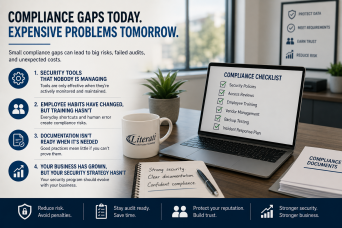
1. Security Tools That Nobody Is Actively Managing
Many businesses have invested in excellent security technologies, including:
- Endpoint protection
- Multi-factor authentication (MFA)
- Firewalls
- Email security
- Threat detection and response
- Microsoft 365 security features
The question isn't whether you own these tools. The question is whether someone is actively managing them.
Ask yourself:
- Are all devices actually protected?
- Are software updates completing successfully?
- Who reviews security alerts?
- Who investigates suspicious activity?
- Are security settings reviewed regularly?
Security software provides value only when it's continuously monitored and maintained. During client audits, cyber insurance applications, or compliance reviews, organizations are increasingly expected to demonstrate that security controls aren't simply installed—they're actively managed.
2. Employee Habits Have Changed, But Security Training Hasn't
Employees don't intentionally create security risks. They're trying to serve customers, meet deadlines, and keep work moving.
Unfortunately, everyday shortcuts often create compliance issues, including:
- Reusing passwords
- Sharing files through unsecured methods
- Clicking phishing emails
- Using personal devices for business work
- Saving sensitive information in unauthorized locations
Technology alone cannot solve these challenges. Regular cybersecurity awareness training, clear policies, and practical guidance help employees recognize risks before they become incidents.
Creating a security-focused culture is one of the most effective ways to reduce both cybersecurity and compliance risk.
3. Documentation Isn't Ready When It's Needed
One of the biggest surprises during an audit or cyber insurance review is discovering that the organization has implemented good security practices—but can't easily prove it.
Documentation should already exist for items such as:
- Security policies
- Employee security awareness training
- User access reviews
- Vendor risk assessments
- Backup testing
- Incident response plans
Waiting until someone asks for documentation creates unnecessary stress and often exposes gaps that could have been addressed months earlier. Good documentation demonstrates maturity, consistency, and accountability.
4. Your Business Has Grown, But Your Security Strategy Hasn't
Technology environments evolve quickly. Over the past year, your organization may have:
- Added employees
- Expanded remote work
- Adopted Microsoft 365 or new cloud applications
- Added third-party vendors
- Opened new locations
- Taken on clients with stricter cybersecurity expectations
Each change affects your security posture. Policies and security controls that worked for a 10-person organization may no longer be sufficient for a team of 30 or 50.
A midyear technology review is an excellent opportunity to verify that your cybersecurity program continues to support how your business operates today—not how it operated a year ago.
Compliance Is About More Than Passing an Audit
Compliance isn't simply about checking boxes. It's about protecting your business, maintaining customer trust, reducing cyber risk, and demonstrating that your organization takes security seriously.
The companies that perform well during audits and insurance renewals aren't necessarily spending more on technology. They're reviewing their security program regularly, documenting what matters, and addressing small issues before they become expensive problems.
How Literati Information Technology Helps Businesses Stay Compliant
Literati Information Technology works with businesses throughout North Central West Virginia, Southwestern Pennsylvania, and Western Maryland to strengthen cybersecurity, improve documentation, support regulatory requirements, and prepare for cyber insurance renewals and customer security assessments.
Whether you're a healthcare provider, engineering firm, construction company, manufacturer, accounting practice, nonprofit, municipality, financial services organization, or professional office, we can help you identify compliance gaps before they impact your business.
If it's been a while since your security controls were reviewed, we'd be happy to schedule a brief conversation to discuss where your organization stands and what opportunities exist to improve your cybersecurity posture.
Phone: (304) 296-8026
Website: https://www.literatiit.com