If you're like many businesses throughout Morgantown, Clarksburg and the surrounding region, January probably feels like a long time ago.
Since then, you've hired new employees, adopted new software, adjusted workflows, and made countless decisions to keep your business moving forward. Whether you're an engineering firm managing multiple projects, a healthcare provider protecting patient information, or a construction company coordinating teams in the field, your technology environment has likely evolved just as quickly as your business.
The challenge is that IT systems change gradually, making it easy to overlook security gaps, outdated permissions, or backup issues until they become expensive problems.
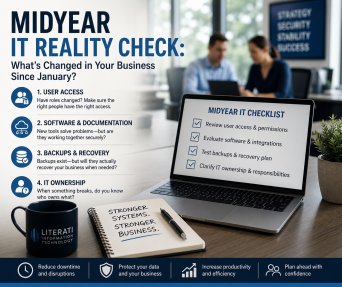
Here are four areas every business should review before the second half of the year gets even busier.
1. User Access Has Changed. Has Anyone Reviewed It?
New employees needed access quickly.
Existing employees changed responsibilities.
Temporary permissions were granted to complete projects.
Third-party vendors may have needed access for support.
Unfortunately, those permissions are rarely reviewed once they're granted.
By midyear, many organizations discover:
- Employees have access to information they no longer need.
- Former employees still have active accounts.
- No one has a clear picture of who can access critical business systems.
This is especially important for organizations using Microsoft 365, cloud applications, accounting software, or industry-specific platforms.
Ask yourself: If someone asked today who has access to your business data, could you answer confidently?
2. Your Software Has Grown Faster Than Your Documentation
Many businesses add software as new needs arise. Perhaps your sales team implemented a CRM. Marketing added new communication tools. Accounting adopted cloud-based financial software. Operations introduced project management platforms.
Each decision solved a problem—but together, they may have created new challenges. Today, your information could be spread across multiple cloud platforms with integrations that haven't been reviewed in months.
Without someone overseeing the entire technology environment, businesses often experience:
- Duplicate data
- Broken integrations
- Inconsistent reporting
- Security gaps between applications
At Literati Information Technology, we frequently help organizations throughout North Central West Virginia identify these hidden inefficiencies before they affect productivity.
3. Are You Confident Your Backups Will Actually Recover Your Business?
Many companies believe they're protected simply because backups exist. But successful recovery depends on much more than having backup software.
Ask yourself:
- When was the last successful restore test?
- How long would recovery actually take?
- Who is responsible for initiating recovery?
- Would your employees know what to do if ransomware struck tomorrow?
Having backups and having a recovery plan are two very different things. The businesses that recover the fastest after an outage are the ones that have already tested the process.
4. Has IT Ownership Become Unclear?
As organizations grow, responsibilities often become blurred. Perhaps your internal staff manages some systems. Your software vendors manage others. Your internet provider handles connectivity. Your cybersecurity vendor monitors threats. Your managed IT provider oversees the rest.
When everything is working, that arrangement seems fine. When something fails, however, it's common to hear: "Who owns this?"
Without clearly defined ownership, issues bounce between vendors, downtime increases, and small problems become larger ones. A documented IT responsibility matrix can eliminate confusion before an emergency occurs.
The Biggest Risks Often Come From Small Changes
The greatest technology risks rarely come from catastrophic failures.
More often, they result from dozens of small changes that accumulate over time without anyone stepping back to review the overall environment.
Businesses that stay ahead of these issues don't necessarily spend more on technology.
They simply maintain visibility into:
- Who has access to business systems
- Whether backups are working
- Which applications store critical information
- Who is responsible when problems arise
That clarity helps organizations operate more securely, reduce downtime, and make better technology decisions.
How Literati Information Technology Can Help
At Literati Information Technology, we help businesses throughout North Central WV and the surrounding region simplify technology management through proactive Managed IT Services, cybersecurity, Microsoft 365 support, backup solutions, and strategic IT planning.
If it's been a while since your technology environment received a comprehensive review, now is an excellent time to evaluate where things stand before small issues become expensive ones.
Contact Literati Information Technology to schedule a no-obligation technology assessment and discover opportunities to improve security, reliability, and efficiency across your business.
Phone: (304) 296-8026
Website: https://www.literatiit.com