
If something disrupted your business tomorrow, would your leadership team know what to do first?
Most business owners would probably say yes. And in many cases, they're right—the people who run the business know their operation well.
But knowing the business and having a clear plan for an unexpected disruption aren't quite the same thing.
We see this all the time with businesses around Morgantown and North Central West Virginia. The important pieces are usually there. Someone knows how to reach the key vendors. Someone else understands which systems are most important. Another person knows what customers need to hear.
The problem is that those pieces may live in different people's heads.
September is National Preparedness Month, which makes this a good time to get your leadership team together and compare notes.
You don't need an all-day planning session or a complicated binder nobody will ever read.
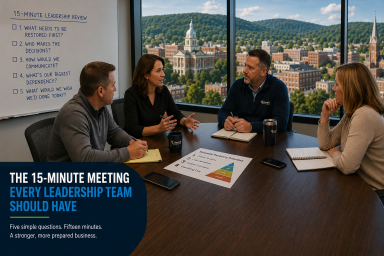
Start with 15 minutes and five questions.
- If our business stopped operating tomorrow, what would need to be restored first?
It's tempting to answer, "Everything."
But that's not really a recovery plan.
Think about what your employees actually need to serve customers and keep the business moving. Depending on your business, that might be scheduling, payment processing, access to customer records, estimating software, accounting systems or shared files.
For an eye care practice, patient scheduling and access to records may be near the top of the list. A construction company may depend heavily on estimating, project management and access to job information. An accounting firm may have completely different priorities.
The important thing is deciding before there's a problem.
When everyone understands what needs to come back first, your team can focus on restoring the most important parts of the business instead of trying to fix everything at once.
- Who makes the decisions during a disruption?
This sounds simple until the normal way of doing business isn't available.
Who decides whether employees should continue working?
Who communicates with customers?
Who contacts your vendors or IT provider?
Who has the authority to make decisions if the owner or another key leader isn't available?
You don't need a complicated chain of command. You just need people to know who's responsible for what.
A few minutes spent answering those questions now can eliminate a lot of phone calls, texts and uncertainty later.
- How would we communicate if our normal tools weren't available?
Most of us don't think much about email, phones or Microsoft Teams when they're working.
We certainly notice when they aren't.
If employees couldn't access company email, how would you give them instructions? If your phone system wasn't available, how would customers reach you? Does your leadership team have everyone's current cell phone numbers somewhere other than your company systems?
Your backup communication plan doesn't need to be sophisticated.
It just needs to answer a simple question:
If our normal way of communicating disappeared tomorrow morning, how would we stay in touch?
- What's our biggest operational dependency?
Every business has something—or someone—it depends on more than it realizes.
Maybe it's your internet connection.
Maybe it's one piece of software.
Maybe it's a third-party vendor.
Or maybe it's the employee who has been there for 15 years and seems to be the only person who knows how a critical process actually works.
None of those things are necessarily problems.
The risk comes from not realizing how dependent the business has become on them.
Ask your leadership team:
"What would become difficult very quickly if we didn't have it tomorrow?"
The answers can tell you where better documentation, a backup option, additional training or some planning might be worthwhile.
- If something happened tomorrow, what would we wish we'd done today?
This may be the most useful question of the five.
Would you wish you'd tested your backups?
Updated an employee or vendor contact list?
Written down an important process?
Made sure someone besides one employee knew how to perform a critical task?
Talked with your IT provider about how quickly important systems could actually be restored?
Most of these aren't big projects.
That's also why they're easy to put off.
Preparedness is really about handling those small things while you have the time to think clearly instead of trying to figure them out while your business is already dealing with a problem.
Where Your IT Partner Fits In
After 15 minutes, you'll probably have two kinds of answers.
There will be things your leadership team feels very confident about.
And there may be a few answers that begin with:
"I think..."
Those are worth investigating.
A good IT partner can help you determine whether your assumptions match what's actually happening behind the scenes. That might mean testing backups, reviewing recovery procedures, documenting important systems or identifying technology dependencies that aren't obvious during normal operations.
At Literati IT, we don't think preparedness needs to become another complicated IT project.
The goal is much simpler: Understand what your business depends on and make sure you have a practical plan for keeping it running.
Put 15 Minutes on the Calendar
That's really the challenge for National Preparedness Month.
Get the people who help run your business together and ask these five questions:
- What needs to be restored first?
- Who makes the decisions?
- How would we communicate?
- What's our biggest dependency?
- What would we wish we'd prepared today?
You may discover you're better prepared than you thought.
And if one or two questions uncover something you're not quite sure about, that's useful too. You've identified it while you still have time to do something about it.
If you'd like another set of eyes on the technology side of your preparedness plan, give Literati IT a call at 304-296-8026. We work with businesses throughout Morgantown, Fairmont, Clarksburg and North Central West Virginia to make technology planning practical and understandable.
No pressure. No technical jargon. Just a practical conversation about whether your technology is ready when your business needs it.